
FREQUENTLY ASKED QUESTIONS
BOND FAQ
Why not build an outdoor pool like White Salmon? It’s only $8M.
Outdoor pools are summer-only. An outdoor pool would mean:
No year-round school swim programs which means many kids won’t learn basic water-safety skills
No competitive swim or water polo teams for kids or high school students
No winter lap swim or therapy
No reliable place for families to swim year-round
It’s cheaper upfront but delivers only a fraction of the value.
Why can’t we just fix the pool? Why not do a smaller bond just to repair it?
The pool may look fine from the outside, because the major problems are underneath. Most of the pool was built in the mid‑1990s, although some concrete dates back to the original 1948 pool. The concrete shell, plumbing, and mechanical systems have all reached or surpassed the end of their intended lifespan.
To “fix” it, crews would have to tear out the deck, dig up pipes, rebuild the shell, and replace all mechanical systems. They would also need to meet today’s safety, accessibility, and energy‑efficiency standards. By the time you do all that, you’ve essentially rebuilt the pool at almost the same cost as a new one — but without the modern safety improvements built into the new facility’s design.
Engineers and pool specialists have been clear: repairing the old pool isn’t cost‑effective or sustainable. Rebuilding is the only long‑term solution.
This design seems too expensive. Why?
Indoor pools are expensive everywhere because of specialized heating, ventilation, & air conditioning (HVAC), mechanical systems, structural requirements, labor costs, and inflation. Parks & Rec explored cost-cutting options, but there are no simple reductions that keep the project safe, code-compliant, and aligned with what residents asked for.
The community asked for basically what we have now:
A competition pool
A warm-water therapy pool
A building that feels open and connected to the outdoors
What happens if voters say no?
Parks & Rec will keep the pool open as long as it is safe, code‑compliant, and financially responsible to operate. Engineers have determined the facility is at the end of its useful life, meaning major failures could occur at any time. Repairs may address short‑term issues but cannot reverse long‑term deterioration. Each issue will be evaluated for safety, cost, feasibility, and community impact. When it is no longer prudent to keep the pool open, Parks & Rec will communicate that decision clearly and with as much notice as possible.
What’s the big deal about swimming lessons?
Drowning is the leading cause of death for children ages 1–4, and the 2nd leading cause of unintentional death for children ages 5-10. Research from OHSU Doernbecher shows that kids who receive water-safety training or swim lessons are 88% less likely to drown.
Parks & Rec partners with Hood River Valley schools so every elementary student can access year-round swim lessons. The pool also supports high school swim teams, water polo, kayak safety, therapy programs, and more. A year-round pool is a core piece of community safety.
Why can’t the new pool be paid for by fees, businesses, grants, fundraising, SDCs, or just certain groups of residents?
Let’s take these one by one:
User fees
Fees help cover operations, but they cannot pay for a major rebuild. Charging full cost would make the pool unaffordable for most families.
Local businesses
Businesses already support the pool through sponsorships. If someone can contribute millions, Parks & Rec would gladly connect them with the Foundation.
Grants
The large state and federal grant programs that once helped build pools no longer exist. Washington State has a program, but Hood River doesn’t qualify because it’s in Oregon.
Fundraising
The HRV Parks & Rec Foundation is working to raise $2 million for add-ons like the splash pad and bleachers. Raising $40 million privately isn’t realistic.
System Development Charges (SDCs)
By law, SDCs can only be used to buy land for new parks, not rebuild existing facilities.
Only Hood River City residents should pay
People from across the Valley use the pool. Many lifelong Valley residents — including our campaign chair, who lived in Odell – learned to swim there.
Well-off households should pay more
Households with higher-value homes already pay more because property taxes are based on assessed value.
Tourists should pay
Tourists already pay higher out-of-district fees. There is currently no legal mechanism to tax tourists specifically for pool construction or maintenance.
Why does the new design look different? Why fewer pools? Why a splash pad?
The new layout is safer. Today, small children and seniors must walk past the deep pool to reach the warm pool — a known safety risk.
All old infrastructure must be demolished, so reconfiguring the layout doesn’t add cost.
The warm pool will combine therapy and wading areas, making it more versatile.
The splash pad is not funded by the bond — it will be built only if fundraising succeeds. The concept drawing simply shows where it would go.
Will the new pool be more energy efficient?
Yes. The current fabric roof loses heat rapidly. Engineers estimate the new building will use about 17% less energy than the current structure. That savings isn’t reflected in early cost estimates because those are based on square footage, not efficiency.
Parks & Rec is also applying for energy-efficiency grants and expects some to be approved.
Will it be in the same location? Will any fields be displaced?
Yes — the pool stays in the same location. No fields will be displaced.
Why not build somewhere else so the pool can stay open during construction?
Building elsewhere would cost significantly more. Parks & Rec also doesn’t own another suitable property.
Westside Park isn’t feasible because it’s inside the National Scenic Area, which would require a lengthy and expensive approval process, which might not be approved in the long run, anyway.
Using land owned by the School District or City would require new agreements, redesigns, and delays. Staying on the current site is the most affordable and straightforward option.
Why not sell Barrett Park and use that money?
Barrett Park was purchased 20 years ago with restricted grant funds that can only be used for outdoor spaces. Selling it would require repaying those grants. No one on the current Board was involved in that decision.
Why did Parks & Rec buy new parks instead of fixing the pool?
New parks were purchased with restricted grants and System Development Charges (SDC), which legally cannot be used to repair or rebuild the pool.
What about families in Parkdale or Odell? The pool’s location isn’t convenient.
You’re right that transportation is a challenge. After the election, we’re committed to working with Parks & Rec to try to improve access for Upper Valley families.
LEVY FAQ
How did we get here? I didn’t know Community Ed programs were at risk.
Back in 2024, Parks & Rec warned that programs would be cut without more funding. They stretched their budget to keep things going for two more years, but the gap hasn’t gone away. Scroll down for more.
Why does Parks & Rec need a levy? Why can’t they just “live within their means”?
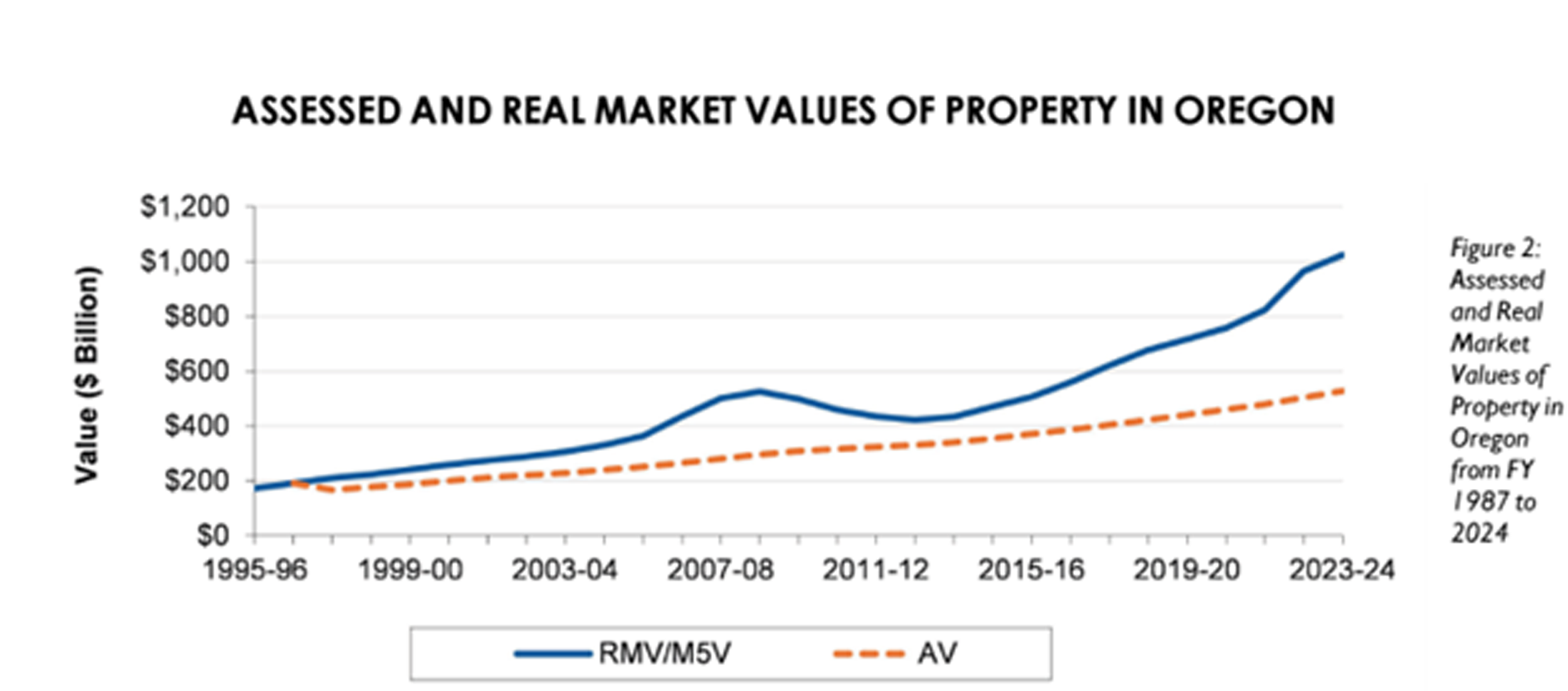
Parks & Rec’s tax rate was set at 35 cents per $1,000 back in the 1990s and hasn’t changed since. Oregon law limits how much your assessed value* can go up each year — no more than 3%, even when market values rise much faster. Because of that cap, Parks & Rec’s revenue has only grown about 27% since 2013.
Costs haven’t stayed that low. Wages — which make up a big part of Parks & Rec’s budget — have gone up 35–40% from 2013 to 2026, according to national data. Other costs like utilities, insurance, and materials have also risen faster than 3% a year.
So the district is working with a 1990s tax rate, modest revenue growth, and 2026‑level costs — a gap they can’t fix without voter approval.
* Assessed value is the number the county uses to calculate your taxes, and in Oregon it can go up no more than 3% a year. Market value is what your home could sell for, and it can rise much faster. Your taxes are not based on market value.
At the same time, the community has asked for more parks, more trails, a year-round pool, and continuance of full recreation programs (Community Ed). Grants help with projects, but they can’t pay for ongoing staff, safety, or maintenance.
What happens if voters say no?
Community Ed programs end after summer 2026
Parks and trails get only basic, reactive maintenance
The pool closes 1–2 days a week
How do trails help with wildfire safety?
Routine trail maintenance includes clearing brush, removing downed limbs, and cutting back overgrown vegetation. This reduces the fuel load that can make wildfires burn hotter and spread faster. Trails also create natural fire breaks with less to burn, and they give firefighters critical access routes for small engines and equipment. Parks & Rec is partnering with the Columbia Land Trust on fuels‑reduction work along the Indian Creek Southside Connector to improve fire safety and strengthen the community’s wildfire preparedness.
Isn’t Parks & Rec less important than police, fire, or schools?
We agree, those services come first. Their tax rate is currently one of the smallest on your bill - about 2%, less than schools, the County, the City and fire districts.
Why did Parks & Rec take over Community Education if the funding wasn’t guaranteed?
Because the programs mattered. Community Ed gives kids and families affordable access to activities they wouldn’t otherwise have.
The School District funded Community Ed for decades, but by 2022 they could no longer afford to continue. Parks & Rec stepped in so the programs wouldn’t disappear. The School District covered two staff positions for three years and continued providing building and field access. Parks & Rec added staff with the understanding that they would ask voters in 2024 to help sustain the programs. With that support, Community Ed was on track to be self‑sustaining by 2025.
When the 2024 levy was voted down, Parks & Rec raised fees and looked for grants, but it isn’t enough to keep the program going long-term.
Why does Parks & Rec keep taking on more responsibilities?
Because residents consistently ask for more parks, trails, and open space. In 2020, all local governments agreed that Parks & Rec would be the lead agency for creating future parks. Other agencies maintain most of what they already own, but they aren’t planning to buy new land. Parks and Rec also historically maintains some City Parks, such as Morrison Park and the Skate Park. If Parks and Rec had not stepped up three years ago to take on Community Education from the School District, it would be gone.
Why not just raise fees and run it like a business?
Parks & Rec already uses fees wherever it makes sense and has raised them in recent years. But parks, trails, and the pool are public services, not private businesses. Charging full cost would make programs unaffordable for most families.
Some costs — like safety staff, maintenance, utilities, and aging facilities — simply can’t be covered by fees alone.
Why doesn’t Parks & Rec take better care of sports fields?
Because most sports fields aren’t owned or maintained by Parks & Rec. They maintain the parks they own; other agencies maintain theirs.
How many people do these programs serve?
Kid and adult Community Ed recreation programs: 3200+
Kid swim lessons: 1500+
How exactly did Parks & Rec get to this point?
Here’s the simple version:
1988: Parks & Rec was created to run the pool.
1990s: The district’s tax rate was set at $0.35 per $1,000 of assessed value.
Early 2000s: Parks & Rec began maintaining some parks and trails through agreements with the City and County, and began to develop new parks.
2022: Parks & Rec took over Community Education recreation programs after the School District could no longer afford to operate them.
2022: A planned levy was postponed, partly due to COVID‑related uncertainty.
2024: A levy was referred to voters, and it did not pass.
2024–2026: Parks & Rec used reserves and raised fees to keep programs going. Reserves are the district’s savings for emergencies and unexpected costs.
Now: Rising costs and no levy mean reserves are running out. Without new funding, Community Ed will end and parks and trails will receive less maintenance. The pool will be closed 1-2 days per week.
TAX IMPACT FAQ
What’s a bond? What’s a levy?
The bond will fund building the pool. The levy will help fund the operation and maintenance of the pool, parks, trails and recreation programs. Building the pool and running the programs will also be supported by grants, partnerships, fundraising and user fees where appropriate.
How much would this increase my TOTAL property tax bill?
Your total property tax bill would go up by about 6–7% if both the pool bond and the Parks & Rec levy pass. Parks & Rec is currently a little over 2% of your property tax bill.
What does this mean for a typical home in the Hood River Valley?
We use the median assessed value — $249,465 — because it shows what a typical homeowner actually pays. Half of all homes are assessed for less than this amount, and half are assessed for more. Using the median avoids the skew that happens when a few very expensive properties raise the average.
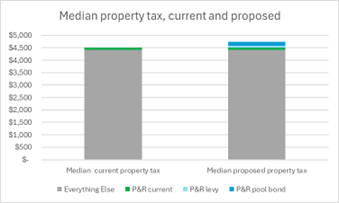
A home with this median assessed value pays under $4,500 per year in total property taxes. That means half of all households in the Hood River Valley pay no more than about $4,500 for all local taxes combined — including County and City taxes, Rural Fire, school levies and bonds, Transportation, Library, Sanitary Districts, and Parks & Rec.
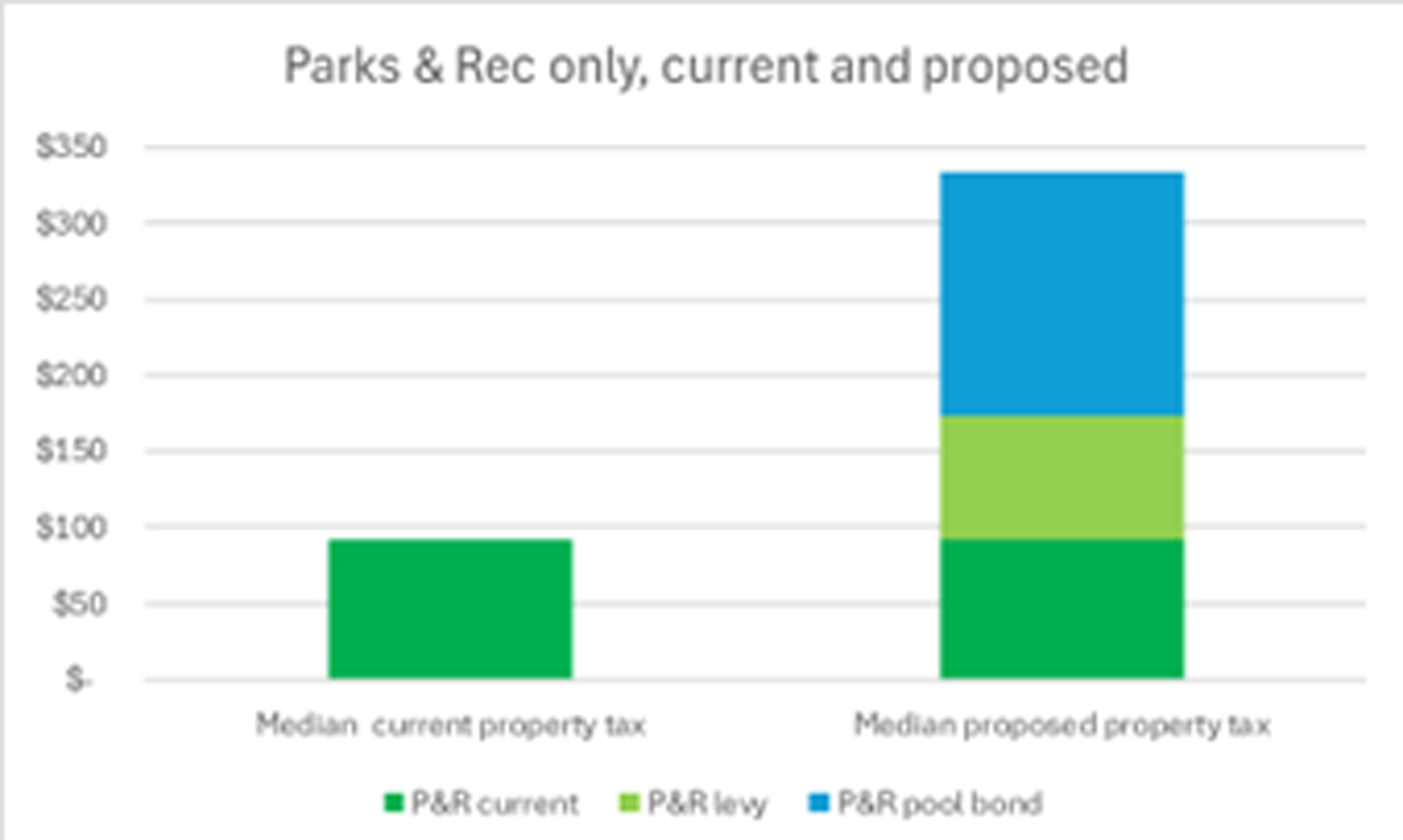
Today, the Parks & Rec portion is $92 or less, which is about 2% of the total tax bill.
Under the proposal:
The Parks & Rec levy would add up to $82 per year.
The pool bond would add up to $160 per year.
If both measures pass, the median total property tax bill would increase from about $4,500 to about $4,742 per year.
The median home price in Hood River Valley is much higher than $249,465.
That’s right. In Oregon, your property taxes are based on your assessed value, not what your home could sell for. That price is the market value.
I’ve heard that other taxing districts, like the City and the School District, are planning to propose new levies soon. Where does it end?
That’s a real concern. Different districts bring measures at different times, and you’ll have the chance to evaluate each one on its own merits. The Parks & Rec levy is simply about keeping basic services running now — parks, trails, the pool, and recreation programs. If it doesn’t pass, those cuts happen immediately because there’s no other operating revenue.
Other districts may or may not move forward with their own levies or bonds, but this measure stands on its own and addresses today’s needs.
WHAT’S DIFFERENT FROM 2024
How are the current bond and levy proposals different from 2024 proposal?
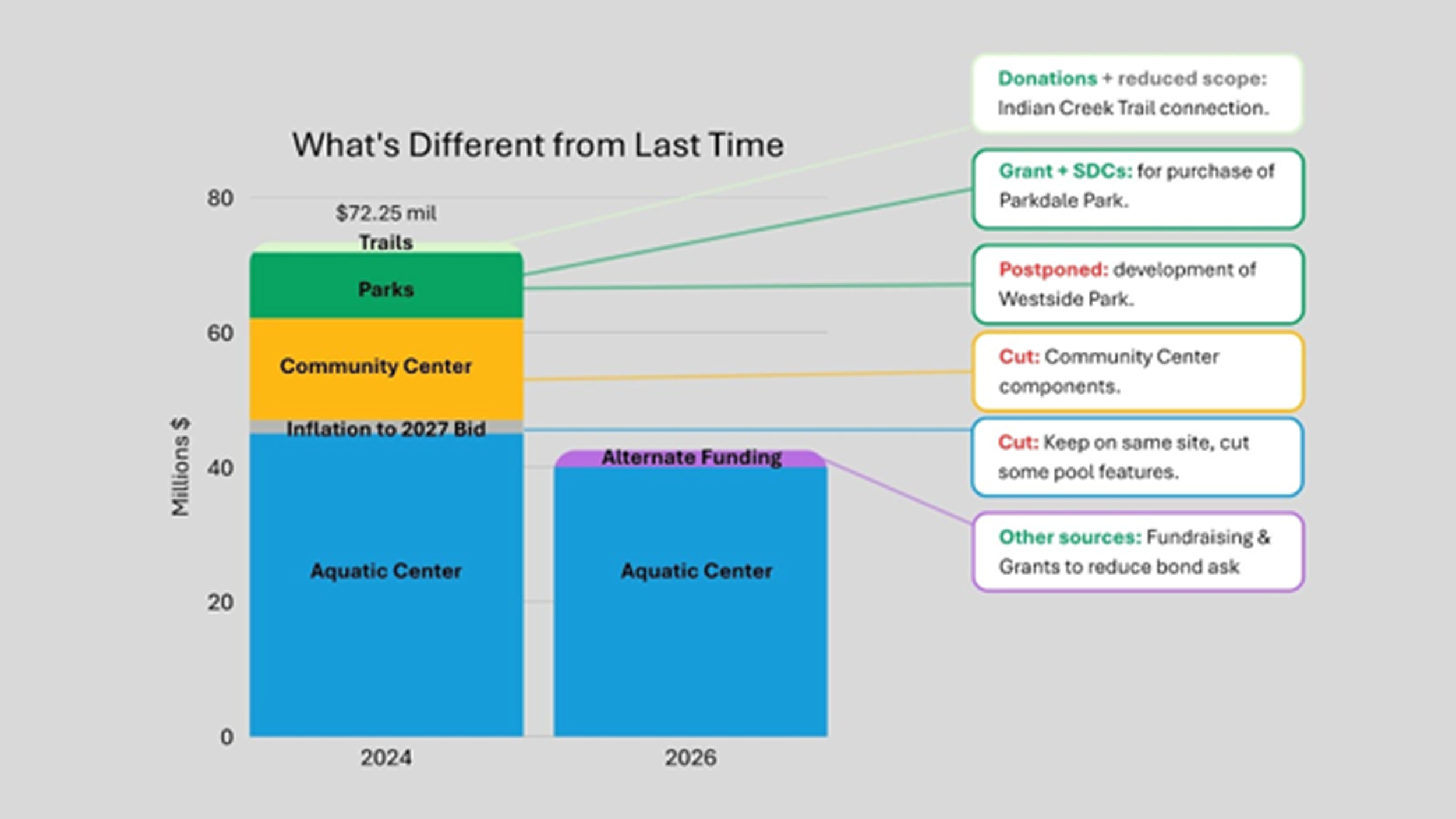
In 2024, voters said the proposal asked for too much. Parks & Rec took that seriously. The 2026 package is a lean, focused plan shaped directly by what we said.
Pool Bond (Capital Measure)
Reduced by more than 40% — a $32 million cut.
Now funds only the replacement of the failing aquatic center.
All non-pool projects from 2024 — Parkdale Park, Westside Park, Indian Creek Trail, and the community center — have been removed.
The new pool is kept roughly the same size as the current one.
Grants and fundraising now cover items that were previously in the bond.
Parks & Rec Levy (Operations)
Reduced 18%, from $0.43 to $0.33
This 5 year levy is separate from the bond and focuses only on basic operations: keeping parks maintained, trails open, and programs running.
·It does not fund construction or expansion.
It will add to the existing levy amount ($0.35 per $1,000 of assessed value) to support Community Education and the additional projects Parks & Rec has taken on at the community’s request. Multiple surveys show that residents value their parks and trails and want more of them. Community Education — which the School District transferred to Parks & Rec three years ago — needs this additional funding to continue operating these programs.
This is a leaner, simpler, lower-cost proposal than 2024 centered solely on fixing the pool and maintaining basic park operations.
OVERSIGHT FAQ
How can we trust that money won’t be wasted during the building process?
We know trust must be earned. That’s why the project will have an Owner’s Representative whose job is to keep the project on schedule, on budget, and up to quality standards. They coordinate the architect, engineers, and contractors and report directly to the Parks & Rec Board.
There will also be an independent oversight committee, like the Pool Advisory Committee, to monitor construction and weigh in on major budget decisions.
Parks & Rec will publish regular public reports so the community can see how tax dollars are being used.
The User survey data says Trails / Parks are equally important as the pool. How will the Board ensure the pool doesn't swallow up all the air in the room and have the trails end up in disrepair?
The survey is right — people value trails and parks just as much as the pool. The Board’s job is to take care of all of it. The levy supports day-to-day operations across the whole system, not just one piece.
The Board can keep things balanced by setting clear budgets for each area, reporting on what’s getting fixed, and using the survey results to guide decisions. The pool is important, but it won’t crowd out the rest — trails and parks stay part of the core work.
The Parks & Rec Board https://hoodriverparksandrec.org/hrvprd-board is made up of volunteers elected by our community. Their meetings are public, with time at the start for anyone to speak. If you have questions or concerns, show up and share them. If you want to help shape Parks and Rec’s direction, you can get involved—or even run for a Board seat yourself.